

Gartner Says Generative AI for Procurement Has Entered the Trough of Disillusionment
Generative AI (GenAI) for procurement has entered the trough of disillusionment, according to Gartner, Inc. While some early adopters are seeing benefits, many organizations are experiencing uneven ROI or falling short of expectations, highlighting the need for a more measured and strategic approach.
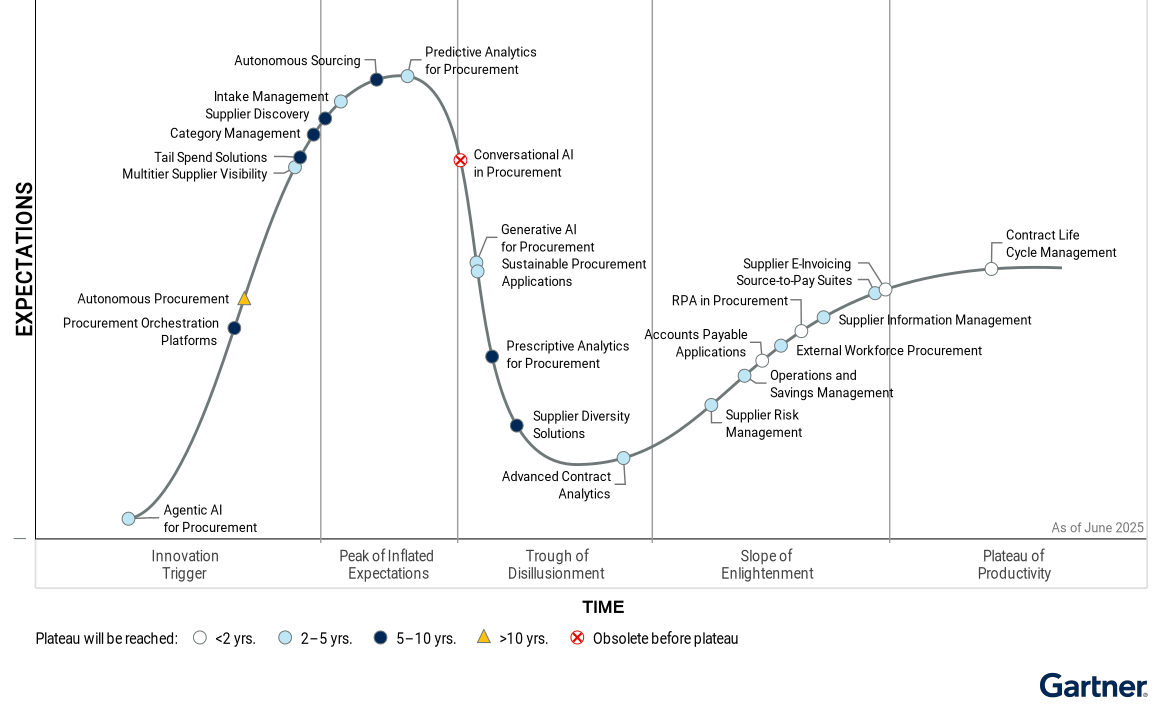
Gartner’s Hype Cycle for Procurement & Sourcing Solutions is a graphical depiction of a common pattern that arises with each new technology or other innovation through five phases of maturity and adoption. Chief procurement officers (CPOs) can use this research to find technology solutions that meet their needs.
Additional procurement technologies in the trough of disillusionment, where interest wanes after surpassing the peak of inflated expectations, include: sustainable procurement applications, prescriptive analytics, supplier diversity solutions and advanced contract analytics, with conversational AI in procurement now projected to become obsolete before reaching productivity (see Figure 1).
Figure 1: Hype Cycle for Procurement & Sourcing Solutions, 2025
Source: Gartner (July 2025)
GenAI for Procurement: Applications
GenAI for Procurement: Adoption Obstacles
CPOs seeking to integrate GenAI into their operations should:
- Invest in data infrastructure to standardize and integrate information across procurement systems for more reliable insights.
- Explore vendors offering embedded GenAI capabilities and assess how these solutions align with enterprise strategies and desired business outcomes.
- Evaluate process-specific AI tools for areas such as sourcing, contract management, and supplier risk where early adopters are seeing benefits.
- Prioritize change management by encouraging learning and adaptation of procurement processes using data insights and automation.
- Monitor evolving regulations to ensure compliant implementation and seek expert guidance as needed.
- Upskill teams in digital dexterity, human-machine interaction, and prompt engineering to prepare for more AI-enabled processes.