

- India’s smartphone export volumes grew 30% YoY in H1 2025, driven largely by a surge in iPhone shipments to the US. This spike followed a tariff announcement by the US government in Q1 2025, prompting Apple to accelerate exports ahead of potential cost hikes.
- The US continued to be the top destination for India’s smartphone exports in H1 2025, accounting for 54% of total shipments, up from 30% in H1 2024.
- The iPhone 16 emerged as the most exported smartphone from India in H1 2025, accounting for 18% of total smartphone exports.
- Motorola became the fastest-growing brand in terms of exports, which grew 7x YoY, with 95% of them going to the US. Motorola’s sales in the US rose 10% YoY in H1 2025, boosted by the early launch of its 2025 G-series line-up compared to the 2024 schedule, capturing tax-season demand.
India’s smartphone exports grew 30% YoY in H1 2025 to reach 40 million units, according to Counterpoint Research’s ‘Make in India Service’. This highlights the sustained momentum in the country’s electronics manufacturing ecosystem and its growing significance in global supply chains. Today, nearly 99% of smartphones sold in India are manufactured locally, reflecting the success of efforts to build a strong domestic production base. This progress has been supported by robust government initiatives like the Production Linked Incentive (PLI) scheme and rapidly expanding local production capabilities, positioning India as a key global manufacturing and export hub for smartphones.
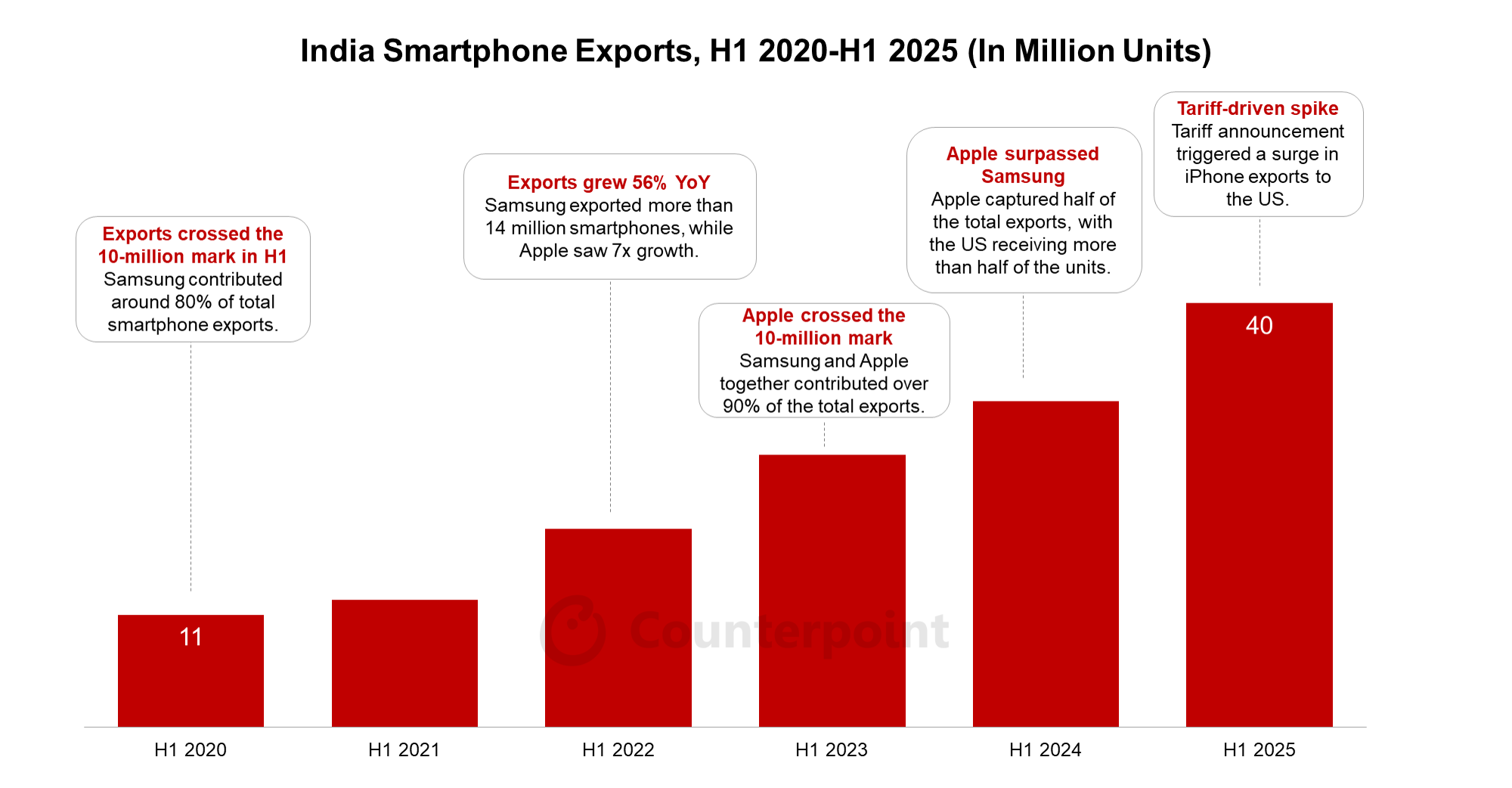
The US continued to be the top destination for India’s smartphone exports in H1 2025, accounting for 54% of total shipments, up from 30% in H1 2024, and over 75% of Apple’s export volumes. A key driver behind this surge was the US tariff announcement in Q1 2025, which led major brands, particularly Apple, to scale up exports from India to avoid potential price hikes in the US market and reduce dependence on China.
Exports to Europe fell 25% YoY, with its share dropping to 27% in H1 2025 from 47% in H1 2024, as Apple redirected a large portion of shipments to the US for inventory buildup. Looking ahead, India is well-positioned to become a key exporter to Europe, driven by the strong export-oriented manufacturing presence of Apple and Samsung in the country, as well as their leadership across most markets in the continent.
Apple’s exports grew 53% YoY, crossing the 20-million mark for the first time in an H1. This growth was fueled by the brand’s expanded manufacturing capabilities in India, supported by a larger production base and favorable government policies. Also, the Trump tariffs played a role in ramping up the export-led manufacturing. iPhones dominated the export charts, capturing the top three spots, led by the iPhone 16 with an 18% share of India’s total smartphone exports, followed by the iPhone 15 and iPhone 16e.
Smartphone exports from Samsung grew marginally at 1% YoY in H1 2025. Over 60% of its exports were directed to Western European markets, such as Austria, Germany, France and Spain. Notably, exports to the US soared 268% YoY in H1 2025. Within Samsung’s exports, the Galaxy A series accounted for three-fourths of the total smartphones exported, highlighting the brand’s continued focus on the mid-range segment.
Motorola became the fastest-growing brand in terms of exports, which grew 7x YoY to reach over 1 million units, with 95% of them going to the US. According to Counterpoint’s Global Monthly Handset Model Sales Tracker, Motorola’s sales in the US rose 10% YoY in H1 2025 as it capitalized on a lack of device refreshes from competing OEMs like HMD, and smaller brands scaling down operations in the US. Motorola launched its 2025 G-series device line-up earlier than it did in 2024, capturing tax-season demand. Motorola also became the third-largest smartphone exporter in India in H1 2025, overtaking Xiaomi and vivo.
Looking ahead, India’s smartphone exports are expected to see continued growth, driven by both the aggressive expansion of OEMs and strong backing from government initiatives like the PLI scheme. However, the recent spike in US tariffs, set to climb to as high as 50% on Indian goods, casts uncertainty over future supply chain dynamics. While smartphones and electronics remain exempt for now, the temporary nature of the exemption makes the path forward unpredictable. OEMs and manufacturers will need to stay agile, navigating evolving trade policies, diversifying markets and pushing for strategic trade agreements to sustain India’s momentum in the global electronics exports landscape.